Showing posts with label Ottoman Empire. Show all posts

Monday, August 19, 2024

Chaldiran 1514: A Turning Point in Ottoman-Safavid Rivalry

The Battle of Chaldiran, fought on August 23, 1514, was a defining moment in the history of the Middle East, marking a significant shift in the balance of power between the Ottoman Empire and the Safavid Empire. This battle, which took place on the plains of Chaldiran in present-day northwestern Iran, set the stage for over a century of conflict and rivalry between these two great empires.

Led by Sultan Selim I, the Ottoman Empire brought a formidable force to the battlefield, with estimates of their army ranging from 60,000 to 100,000 soldiers. The Ottomans were particularly well-equipped with a modern arsenal that included cannons and muskets, giving them a critical technological edge. In contrast, the Safavid army, under the command of Shah Ismail I, was composed of 40,000 to 80,000 soldiers, predominantly cavalry. The Safavids lacked the artillery that would prove decisive in this confrontation.

The technological disparity between the two forces played a crucial role in the battle's outcome. The Ottomans' strategic deployment of artillery, combined with their disciplined infantry formations, proved overwhelming for the Safavid cavalry, which was repeatedly repelled and decimated by Ottoman firepower. The Safavid forces suffered catastrophic losses, and Shah Ismail I, wounded in the fray, narrowly escaped capture.

The defeat at Chaldiran had far-reaching consequences for the Safavid Empire. It shattered the myth of Shah Ismail's invincibility, a belief that had been deeply ingrained among his followers due to his previous military successes. This loss not only weakened the Safavid military but also led to a significant shift in regional power dynamics. The Ottomans, capitalizing on their victory, annexed Eastern Anatolia and Upper Mesopotamia, significantly expanding their empire's territory. They even briefly occupied the Safavid capital, Tabriz, looting its treasures and further diminishing the Safavids' power.

The Battle of Chaldiran also marked the beginning of a prolonged period of intermittent warfare between the Ottoman and Safavid empires, a conflict that would persist until the Treaty of Zuhab in 1639. This battle is remembered not just for its immediate military and territorial outcomes but also for its long-term impact on the region's political and religious landscape. It highlighted the strategic importance of artillery in warfare and solidified Sultan Selim I's legacy as a formidable military leader, while the Safavids were forced to rethink their military strategies and their role in the evolving power dynamics of the Middle East.
Chaldiran 1514: A Turning Point in Ottoman-Safavid Rivalry
Selim I

Wednesday, July 24, 2024

The Balkan Wars and the Decline of the Ottoman Empire

In the early 20th century, the Ottoman Empire faced significant challenges from the Balkan states. Before the conclusion of the Italo-Turkish War (1911-1912), Bulgaria and Serbia declared war against the Ottomans. Shortly thereafter, Greece joined the conflict. Their collective aim was to expel the Turks from Europe and reclaim territories.

The ensuing conflict saw brutal violence, with Balkan Christians ruthlessly slaughtering Muslim populations. Amid the chaos, a temporary peace was brokered in London. As part of the negotiations, Bulgaria occupied Edirne, demanding its cession as a condition for permanent peace. This demand was unacceptable to the Ottoman Empire. In January 1913, the major European powers advised the Ottoman Khalifah to relinquish Edirne to the Balkan states.

The Grand Vizier, Kamil Pasha, an ally of Britain, agreed to consider this advice. However, just as acceptance seemed imminent, Enver Pasha, who had recently returned from the Tripoli campaign, dramatically intervened. Enver Pasha stormed the Grand Vizier’s palace and assassinated Nazim Pasha. This act led to the resignation of Kamil Pasha and the appointment of Mahmud Shevket Pasha as the new Grand Vizier.

With this change in leadership, the temporary peace collapsed, and hostilities resumed. The Ottoman armies suffered defeats, notably at the hands of the Bulgarians. Greece also renewed its offensive, capturing Samos Island. By March 1913, Bulgaria had occupied Edirne, solidifying its position.

In April 1913, another temporary peace agreement was reached between the Ottoman Empire and Bulgaria. This period marked a significant loss of Ottoman territories in Europe and a shift in the region's power dynamics, setting the stage for further conflicts and shaping the geopolitical landscape of the Balkans.

The war underscored the declining power of the Ottoman Empire and the rising influence of the Balkan states, influencing subsequent historical developments in the region.
The Balkan Wars and the Decline of the Ottoman Empire

Saturday, June 25, 2022

Crimean War

Crimean War, was a military conflict from October 1853 to February 1856 fought mainly on the Crimean Peninsula between the Russians and the British, French, and Ottoman Turkish, with support from January 1855 by the army of Sardinia-Piedmont.

It was first and foremost the embodiment of a ‘modern war’, using new technologies that would later characterize the wars of the next century.

The spark that set off the war was religious tension between Catholics and the Orthodox believers, including Russians, over access to Jerusalem and other places under Turkish rule that were considered sacred by both Christian sects.

In July 1853, Russia occupied the Danubian Principalities (Moldavia and Walachia) to pressure Istanbul, but this threatened Austria’s economic lifeline - the Danube.

In June 1854, British and French armies concentrated at Varna on the Black Sea with a view to supporting the Turks.

On 20 September, the Allies attacked and, despite confused leadership, the British stormed the main Russian position. The Russians retreated, having lost 5,000 men. The Allies had lost 3,000.

On 30th March 1856, the Crimean War was formally brought to an end with the signing of the Treaty of Paris. The main agreement did manage to create some tangible guidelines which included forcing Russia to demilitarize the Black Sea. This agreement was between the Tsar and the Sultan who maintained that no arsenal could be established on the coastline.

The human cost was immense, 25,000 British, 100,000 French and up to a million Russians died, almost all of disease and neglect. The war weakened the Imperial Russian Army, drained the treasury and undermined Russia's influence in Europe.
Crimean War

Saturday, January 8, 2022

Auspicious Incident – the event of forced disbandment of Janissary corps

Auspicious Incident a bloody repression during which thousands of Istanbul’s Janissaries were massacred and their barracks demolished. It was the forced disbandment of the centuries-old Janissary corps by Sultan Mahmud II on 15 June 1826. The so-called Auspicious Incident of 1826 was a true massacre, a bloody annihilation of thousands of men who were literally blasted away by the forces of modernism.

The Janissaries were first created by the Ottoman Sultans in the late 14th century and the creation of the Janissary Corps in the fourteenth century represented the establishment of one of the first standing armies in Europe.

The Janissaries boasted, and not without considerable cause, that they never turned their backs upon an enemy. Indeed, they passed from victory to victory, transforming a small frontier principality into the last great medieval Islamic empire. The supreme prowess and discipline of the Janissaries allowed them to become increasingly powerful in the palace. From the reign of Bayezid II (1481–1512), they regularly required sultans to provide extra pay in exchange for the support of the corps.

According to historian, Janissaries had begun to present a serious threat to the Empire. On the battlefield they were gaining a reputation among the modern foreign armies for ineptitude and even cowardice under arms and in the capital, they came to be a dominant power and a focus of sedition.

One of Sultan Mahmud II’s major goals for his reign was to modernize and westernize the Ottoman Empire, which was bad news for historical relics like the Janissaries. On learning of the formation of new, Westernized troops, the Janissaries revolted. After Mahmud II received news of the Janissary rebellion, he ordered his barge launched and immediately started for the palace.

Sultan Mahmud II declared war on the rebels and, on their refusal to surrender, had cannon fire directed on their barracks. The Sultan ordered criers sent to all corners of the Istanbul, Galata, Pera and Scutari to encourage all Muslims to join him in defeating the Janissary rebels.

Driven back from the barracks’ gate, the Janissaries broke rank and fled. Gunfire from the Sultan’s troops cut down most of the fleeing rebels, but some managed to reach the temporary safety of their immense wooden barracks. Most of the Janissaries were killed, and those who were taken prisoner were executed.

With a military action that lasted less than six hours from start to finish, the Ottoman Porte destroyed the Janissaries.
Auspicious Incident – the event of forced disbandment of Janissary corps

Thursday, December 5, 2019

Weaponry of the Ottoman Empire

The Ottoman Empire, founded by Osman I (r. 1290-1326), dominated much of southeastern Europe, the Middle East, and North Africa between the fourteenth and early twentieth century.

In the early centuries the Ottomans effectively used siege weapons and artillery, such as mortars, catapults, and large cannons, that fired both iron and stone shot. Mehmed II, also called Mehmed the Conqueror, wished to have the most modern weapons and ordered a Hungarian gunsmith to build him large cannons, one of which was used at Constantinople, that could fire 1,200-pound cannonballs.

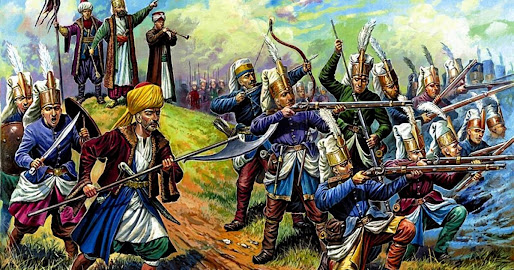
Janissaries used scimitars, knives, stabbing swords, battle-axes, and harquebuses. Their adoption of firearms as their weapons of choice must have occurred sometime before the 1449 Battle of Kossovo Polje, making them the first elite battle-winning infantry unit in Europe to adopt gunpowder weapons as their weapon of choice.

The Janissaries were firing their weapons row-by-row from the early 16th century. It seems, however, that Janissaries started to use volley fire of the West European type only in the1590s.

Gunpowder played a crucial role in the Ottomans' conquest of Constantinople in 1453. The Turks were also skilled marksmen using muskets.
Weaponry of the Ottoman Empire

Tuesday, September 6, 2016

Battle of Vaslui

The Battle of Vaslui was fought by Stephen III of Moldavia on January 10, 1475, against Ottoman Beylerbeyi of Rumelia, Hadım Suleiman Pasha.

Battle of Vaslui was also referred to as the Battle of Podul Înalt or the Battle of Racova. In this battle, Stephen of Moldavia faced the biggest Ottoman army ever assembled during the Battle of Vaslui where the Ottomans outnumbered the Moldovans 3 to 1 and were better equipped.

Battle of Vaslui
Hadim Suleyman Pasha led an army of about 120,000 men to restore Ottoman authority in the region. Gathering 40,000 men and supported by Hungarians and Poles, Stephen met the enemy at Podul Înalt, near the town of Vaslui.

The Moldavian success in this battle and the Turks were forced to withdraw. Stephen was named the ‘athlete of Christ’ by Pope Sixtus IV for his resistance to Ottoman expansion, but he received little help from other European rulers.

He withstood a further Turkish invasion in 1884, but at the cost of the parts of Chilia and Cetatea Alba, and finally agreed to pay tribute to the Turks as the price of Moldavian independence.
Battle of Vaslui

Tuesday, October 13, 2015

Siege of Belgrade (1456)

Ottoman siege of Belgrade happened from July 4 to 22, 1456, broken when a relief force led by John Hunyadi defeated the Ottoman forces in a battle outside the city.

Having captured Constantinople in 1453, Mehmed II marched his Ottoman Turks into the Balkans. Southern Serbia fell under his control.

Although George Brankovic of Serbian kingdom signed treaty with Mehmed to respect what remained of his kingdom, the Mehmed II returned in 1456 with invasion army.

Janos Hunyadi defeats Turks in 1456
His invasion force of around 100,000 reached Belgrade in July 4, Mehmed deployed almost 200 guns in his siege lines and guarded the Danube and the marshes to the northeast of the city.

Mehmed’s guns had breached the fortifications of the city in a number of places, and on July 21, Mehmed ordered an assault.

The city seemed doomed, but Janos Hunyadi, led a Hungarian army to relief of Belgrade.  The following day Christian forces raided the Ottoman lines. This attack was reinforced by forces under the command of Giovani de Capistrano, despite the fact that Hunyadi had instructed his forces not to bring in a general engagement.

Ottoman forces were caught off guard and began to flee. His 1456 siege of Belgrade failed, but Mehmed did seize areas in the Peloponnesus and captured Trebizond in the early 1460s.
Siege of Belgrade (1456)

Monday, September 7, 2015

Battle of Başkent

Battle of Başkent was a battle between the armies of Mehmed II and the Ak Koyunlu ruler Uzun Hasan on the plain of Tercan near Erzurum. The Battle of Başkent also known as Battle of Otlukbeli.

The expansionist drive of Mehmed II into Anatolia impelled the Ak Koyunlu, who ruled Iran and southern Caucasus to form an alliance with Venice and other Christian powers. Venice, a long time naval power in the Levant had hoped for control of a port on the Syrian or south Anatolian coast and to that end had attempted a military alliance with Uzun Hasan.

Both the Ottoman and Ak Koyunlu armies were ready for a final confrontation. Finally, on 11 August 1473, in a pitched battle at Başkent near Otluk Beli, Uzun Hasan’s army was completely routed.

The Venetians, who at that time were at war with the Ottomans, sent artillery units to support the Ak Koyunlu. Though the Ak Koyunlu army was superior in terms of manpower, the Ottoman troops were better organized and equipped. In this battle, Ottoman artillery employed in concert worth war wagons created havoc within the ranks of the nomadic Ak Koyunlu army. While other factors such as discipline were important, the artillery overshadowed the rest.

The battle took nearly a whole day. With this defeat, the Ak Koyunlu in effect no longer played a serious role in the great power’s struggle for Anatolia.
Battle of Başkent

Thursday, September 11, 2008

Spain is The Great Power in The 16th Century

Spain is The Great Power in The 16th Century
By middle of the sixteenth century Spain was the greatest power in Europe. The dominions of Philip II (1556 – 98) of Spain stretched from the Atlantic to the Pacific: his continental territories included the Netherlands in the North and Milan and Naples in Italy.

In 1580 Philip II became king of Portugal, uniting all the states of the Iberian Peninsula. With the addition of Portugal’s Atlantic ports and its sizeable fleet, Spanish maritime power now was unsurpassed. Spain was also a great cultural and intellectual center. The fashions and tastes of its golden age dominated all the courts of Europe. The expansion of Spanish domination and the increase of Spain’s wealth and prestige was reflected in a self conscious spirit of national pride that could be seen in the story of Don Quixote, the knight who tilted at windmills in search of greatness in the novel published by Miguel de Cervantes between 1605 and 1615.

In Mediterranean Spain alone stood out against the expansion of Ottoman power. The sultan’s navy continually threatened to turn the Mediterranean into a Turkish lake, while his armies attempted to capture and hold Italian soil. All Europe shuddered at the news each Ottoman advance. Pope called for holy wars against the Turks but only Philip heeded the cry. From nearly moment that he inherited the Spanish crown he took up the challenge of defending European Christianity.

For over a decade Philip maintained costly coastal garrison in North Africa and Italy and assembled large fleets and larger army to discourage or repel Turkish invasions. This sparring could not go on indefinitely, and in 1571 both sides prepared for a decisive battle. A combined Spanish and Italian force of over three hundred ships and eighty thousand men meet an even larger ottoman flotilla off the coasts of Greece. The Spanish naval victory of Lepanto was considered one of the great events of the sixteenth century, celebrated in story and songs for the next three hundred years, though the Turks continued to menace the Mediterranean islands, Lepanto marked the end of Ottoman advanced.
Spain is The Great Power in The 16th Century

The most popular articles

Other interesting articles

BannerFans.com
BannerFans.com BannerFans.com BannerFans.com